Where’s the Money? Federal Funding in AI Today
As developments in artificial intelligence continue to multiply, AI isn’t just the next big thing in the tech space — governments are beginning to invest in it, too. Earlier this year, the White House unveiled its AI Action Plan, a road map intended to accelerate innovation and infrastructure for this brand new technology. With over ninety policy objectives spread across all three branches of government, these outlined goals are no small initiative.
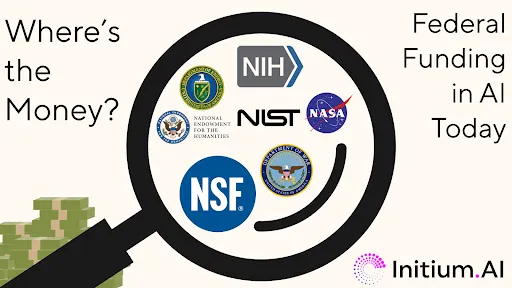
But what does this new, massive undertaking mean for writing proposals? For researchers and grant writers that keep a close eye on federal funding, the AI Action plan will have major effects on what grant calls are put out and to whom. In this blog, we’re trying to walk you through some of the major federal focuses on AI today.
NSF Programs
The National Science Foundation is, rather predictably, one of the government institutions with the most AI-related grant offerings. One of the most prominent examples of this new investment is the NSF’s National AI Research Resource Pilot Plan (NAIRR) which “aims to connect U.S. researchers and educators to computational, data, and training resources needed to advance AI research and research that employs AI”. In their short lifespan, they have so far managed to support over 500 research projects that relate to AI in every field from agriculture to clinical medicine to sociology. They also offer community workshops, start-up project funding, and classroom resources.
In September, NAIRR also expanded its reach with the announcement of the NAIRR Operations Center, created with the goal of building a national infrastructure to drive innovation and train future generations in AI. NAIRR-OC is currently asking for proposals to help build a community-based hub, including incorporating computer and data resources, efficient access to AI tools via a web portal, and working together with partner organizations.
Beyond NAIRR initiatives, the NSF itself also has its own AI focus areas through which funding is distributed: fundamental AI discovery in science and engineering, translating AI innovation into economic impact, AI resources and infrastructure, and creating an AI-trained workforce. Notably, these sections are intentionally broad; a quick search of the available AI-related RFPs on the NSF website range from the intersection of biology and AI to cybersecurity.
These add to the more set of existing programs that have traditionally supported the development of AI. The NSF Division of Information and Intelligent Systems (CISE/IIS) has long supported research into interactions between people, computers, and information — AI included. Their funding opportunities range from basic and applied scientific research to smart health and biomedical research.
Other Government Programs
The NSF is far from the only government agency invested in funding AI, many other institutions offer grants as well. Perhaps the most obvious of these is the NIH, which takes a more biomedical and clinical approach to AI research. The NIH’s program Bridge2AI program focuses on propelling “biomedical research forward by setting the stage for widespread adoption of artificial intelligence (AI) that tackles complex biomedical challenges beyond human intuition”, including creating new data sets and best practices for ML analysis. While there are currently no open calls, Bridge2AI does offer a comprehensive suite of tools, including interactive maps and open-source code libraries for researchers. Moreover, like the NSF, the NIH offers its own grants, too: it recently opened a call for up to $10 million to create new imaging AI models to meet unmet clinical needs as part of their PRIMED-AI program, which focuses on harnessing AI to integrate imaging and other clinical data.
The Department of Defense also has no shortage of AI-related funding. DARPA (Defense Advanced Research Projects Agency) currently runs three AI programs: Artificial Intelligence Reinforcements, Artificial Intelligence Quantified, and Securing Artificial Intelligence for Battlefield Effective Robustness. Each of these programs occasionally offer R&D funding.
NASA also offers notable AI funding. They currently have an RFP due in February 2026 soliciting calls for research about developing initiatives for new technology (including AI). Depending on your research, it may also be worth looking into this year’s omnibus funding for basic and applied research, christened ROSES (Research Opportunities in Space and Earth Sciences).
The Department of Energy is heavily focused on AI as well. The DOE sponsors AI-related research in three areas: AI for Science, AI for Energy, and AI for National Security. Additionally, they also offer programs in developing a workforce focused on and/or fluent in AI, with workforce training opportunities like Introduction to AI-driven Science on Supercomputers and the Computer Science Research Institute R&D Graduate and Undergraduate Summer Intern Program.
Beyond STEM-related government departments and agencies, the National Endowment for Humanities also offers AI funding. An upcoming RFP, expected to be available in July of 2026, will seek applicants/institutions who will construct a humanities research center that focuses on researching and spreading reliable information about AI. The center will also contain lecture series, workshops, a journal, and/or articles for the general public. Grants based on collaborative research and fellowships are also offered to scholars studying AI.
Finally, the National Institute of Standards and Technology recently released their AI “Zero Drafts” Pilot Project. While it doesn’t offer any funding, they are currently requesting input on “developing AI standards more quickly while encouraging openness and collaboration”, which could help AI researchers and writers form valuable connections, to say nothing of an extra resume boost!
Federal collaborations with private companies
While not entirely government-led, the White House has forged significant partnerships with various private businesses to advance AI research and development. AI tech stars OpenAI and Oracle are co-creating Stargate with the US government, a venture that will build AI data centers in the country with the goal of creating 100,000 jobs. The collaboration is part of the White House’s January announcement to invest up to $500 billion in the private sector to build AI infrastructure. On the flip side, Microsoft is providing their suite of AI tools to the government to accelerate usage and development of AI in the federal workforce.
The US government and private industry are also collaborating in supporting programs via funding. For example, the NSF and AI superpower NVIDIA are giving a combined $152 million to Ai2, a nonprofit research institute aiming to make bold, breakthrough discoveries in AI.
With such a wide range of focuses and funding in AI, the federal government’s AI action plan has something for everyone! Let us know if you have any questions about these programs — or if you think we missed one! As always, we wish you the best of luck in your grant writing journey, and hope that this post helped you find new opportunities and tools to accelerate the process.